

Make Waves Wisely: Responsible Wake Boat Use on Walloon Lake
By Laura Morris
Director of Outreach & Community Engagement
It’s a hot, sunny day in Northern Michigan. You’ve waited all winter for this moment—the blue skies and sparkling water are calling. Cruising, tubing, water skiing, fishing, wake surfing—life on the lake is meant to be enjoyed. But as stewards of Walloon Lake, we also have a responsibility to understand how our boating choices affect the water beneath us and the health of the lake.
When it comes to powerboats, the impact from wake boats (especially in wake surfing mode) is far greater than many people realize. While shoreline erosion is the most visible effect, the ecological impact extends deep below the surface—affecting fish habitat, water clarity, and nutrient balance.
How Powerboats Affect the Water Column
A recent University of Minnesota (UMN) field study evaluated how powerboats influence inland lakes. Researchers found that every motorized boat produces three types of hydrodynamic forces:
- Bow and stern waves — reach deep into the water column and move sediment.
- Transverse Gravity waves — large rolling waves that persist long after a boat passes.
- Propeller wash — a turbulent jet that can shear plants and stir sediment.
All boats create these forces, but wake boats amplify them dramatically.
Why Wake Boats Have Greater Impacts
Wake boats are engineered to create the largest, most powerful surfable wave possible. Ballast tanks, hull shape, and propulsion systems push more water deeper into the water column with far more energy than traditional boats.
This means that even when a wake boat is operated “far enough” from shore, it may still be impacting the lakebed, stirring nutrients, and sending large waves toward docks and natural shorelines.
According to Michigan DNR Research
- Wake boats produce waves with 1.7–17× more energy than typical speedboats.
- Their wakes take 225–950 feet to dissipate (vs. 100–200 feet for other boats).
- Propeller wash can disturb sediment in up to 30 feet of water.
Depth Matters
Because wake boats push waves so deeply into the water column, depth is the single most important factor
in reducing ecological impact.
Why WLAC Has Updated Recommendations
The UMN study is the most comprehensive evaluation of wake boat impacts on inland lakes to date. It measures how wake-enhancing technologies change the movement of water throughout the entire water column—not just at the surface.
Unlike traditional boats, which send most of their force outward, wake boats push energy downward, increasing the likelihood of disturbing lakebed sediment, uprooting vegetation, and resuspending nutrients.
For Walloon Lake, this is especially important. While the lake has deep basins, its average depth is only 30 feet and it is relatively narrow. This means wake activity can easily affect the lakebed or send waves toward shorelines.
WLAC’s updated recommendations emphasize both minimum depth and minimum distance to protect water quality.
Wake Boats
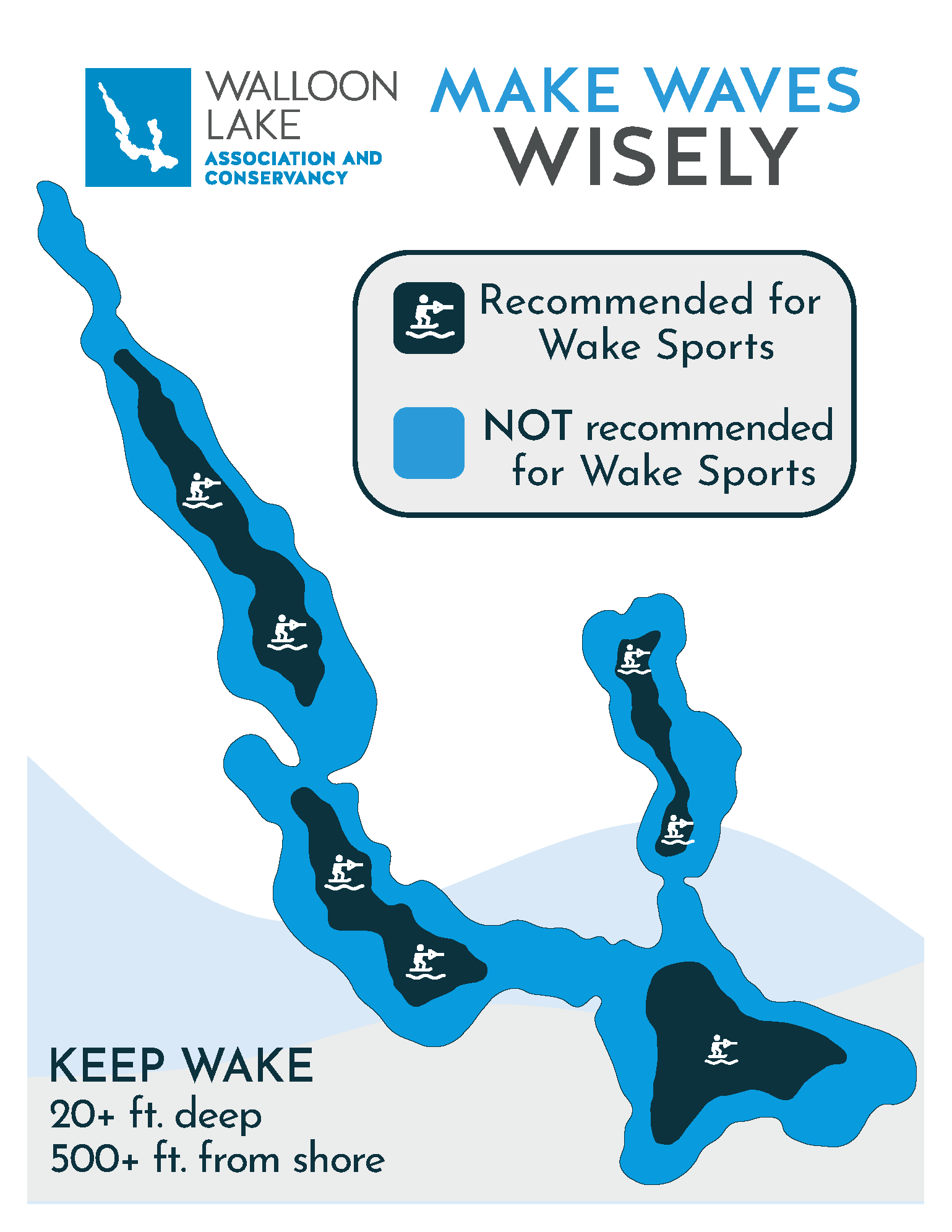
- Operate in “surf mode” only in water deeper than 20 feet.
- Make wake at least 500 feet from shorelines, docks, and other boats.
- Reference the Wake Boat Map and stay near the center of the lake whenever possible.
All Motorized Boats
- Minimize wakes in water less than 10 feet deep.
- No wake speed within 200 feet of shorelines and docks.
(Click to Enlarge)
See the University of Minnesota Research in Action
Click the video below to watch wave action:
Where to Wake Responsibly
WLAC has created a Wake Boat Map highlighting areas where depth and distance make wake surfing more appropriate.
Even in these areas, boaters should remain aware of other vessels and avoid making wake within 500 feet from others.
Enjoy, Respect, & Protect the Lake
At WLAC, we understand the joy of boating in all its forms. By aligning our recommendations with the best available science,
we’re ensuring that wake sports can continue in ways that respect the lake’s ecology, its shorelines, and everyone who enjoys being on the water.
For more information, visit our safety page.