

A Sanctuary for Loons
By Tanner Yurk
Conservation Program Manager
When you hear a wail of the Common Loon, you know summer is here. For many of us, it’s a welcome sign of home in northern Michigan, but more importantly, that call is a measurement of our success. As a sentinel species, loons are living proof that Walloon’s water remains clean and its food chain is intact. If the loons are thriving, we know we’re doing our job.
However, as boat traffic and shoreline development increase, our loons are running out of quiet, stable places to hatch the next generation. Human activity and habitat degradation have made common loons a threatened species in Michigan since 1987. This season, we’re taking a direct step to help with that.
Solving the Shoreline Problem
Loons are elite divers, but they are nearly immobile on land. Their nests are traditionally built right at the water’s edge, making them incredibly vulnerable. A single heavy spring rain or a large boat wake can flood a nest in seconds, destroying an entire year’s reproductive effort.
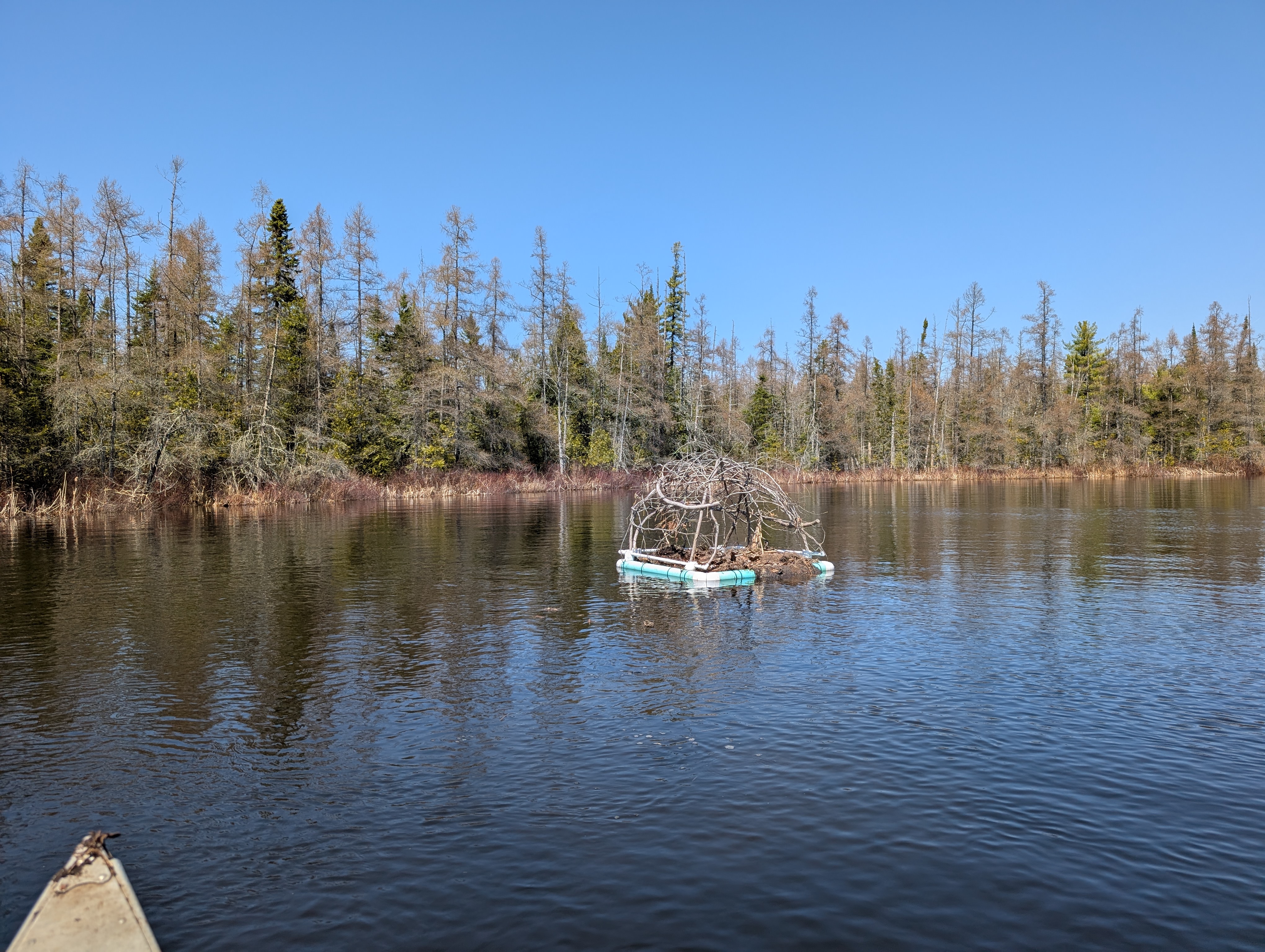
To counter this, four dedicated Walloon Lake volunteers recently constructed an artificial nesting platform. Unlike a natural shoreline nest, this platform floats. It rises and falls with fluctuating water levels, keeping the eggs dry and safe. We’ve anchored it securely and topped it with natural vegetation to mimic the marshy hummocks loons prefer, providing cover from aerial predators like eagles and gulls.
Schoof’s Creek Nature Area
After evaluating wind exposure and high-traffic zones, we have positioned the platform just east of Schoof’s Creek directly adjacent to our Schoof’s Creek Nature Area in the North Arm. This area offers the necessary shelter while providing the pair with quick access to the deep, clear water they need for hunting.
To give this nesting pair the best chance of success, we have established a 300-foot protection perimeter. You will see specialized warning buoys marked “Caution Area: Loon Nesting” around the site that will be out during the breeding season (April-July).
A Direct Request to Boaters
If you are on the water in this area, please treat this 300-foot buffer as a strict no-entry zone.
Loons are notoriously shy parents. When a boat or kayak gets too close, the adult’s first instinct is to flatten itself against the nest to hide. If the approach continues, they will abandon the nest for the water. This leaves the eggs exposed to the cold air and predators. Even a few minutes of human curiosity can result in a failed nest.
By giving these creatures the space they need, we aren’t just protecting a bird; we are protecting the very thing that makes Walloon feel like home. If the loons are thriving, we know our lake is, too.
The Loon Watcher’s Guide
Red Eyes: Have you ever wondered why loons have such striking red eyes in the summer? This pigment is thought to help filter blue and green light, allowing them to see more clearly while hunting underwater. In the winter, their eyes fade to a duller grey or brown.
Bird Submarines: Unlike most birds, loons have solid bones rather than hollow ones. This extra weight acts like a diver belt, allowing them to dive up to 200 feet deep. However, this density makes taking off difficult; they require a “runway” of 30 yards and up to a quarter mile of open water to flap and run on the water for take-off.
Onboard Nursery: After the chicks hatch, you may see them hitching a ride on their parents’ backs. This isn’t just for rest; it keeps the chicks warm and protects them from underwater predators like large pike or snapping turtles.
Lead-Free Fishing: Loons often swallow small pebbles to help grind food in their gizzards. Unfortunately, they can mistake lead sinkers for these stones. A single lead jig is fatal. Please check your tackle box and switch to non-toxic alternatives like tungsten or steel.
A Guide to Loon Language
| Call | What it sounds like | What it means |
| The Wail | A long, haunting wolf-like howl. | “I’m over here—where are you?” Used to locate mates or social groups in the area. |
| The Tremolo | A rapid, wavering “laughing” sound. | “I’m nervous/alarmed!” This is a distress signal. If a loon “laughs” at your boat, you are too close! |
| The Yodel | A complex, long, and wild rhythmic song. | “This is my territory!” Given only by males to warn off rivals. It is a sign of high-intensity defense. |
| The Hoot | A soft, short, quiet “coo.” | “Stay close.” An intimate check-in used between mates or parents and their chicks. |
References and Citations
Audubon (n.d.). Audubon, Bird Guide, Common Loon. https://www.audubon.org/field-guide/bird/common-loon
Cornell Lab of Ornithology (n.d.). Cornel Lab of Ornithology, All About Birds, Common Loon. https://www.allaboutbirds.org/guide/common_loon
Kenow, Kevin (2018, April 3). Factors Affecting Common Loon (Gavia immer) Productivity. Upper Midwest Environmental Sciences Center. United States Geological Survey. https://www.umesc.usgs.gov/terrestrial/migratory_birds/kkenow_5003686.html
Michigan Department of Natural Resources (n.d.). Getting the Lead Out: Reducing Lead Poisoning in Fish and Wildlife. https://www.michigan.gov/-/media/Project/Websites/dnr/Images/WLD/misc/getting_the_lead_out.pdf?rev=d720d5b83d904230bc50192a1a0884ee
National Loon Center. (n.d.). Ask the scientist. https://www.nationallooncenter.org/ask-the-scientist/
National Wildlife Federation (n.d.). Common Loon. https://www.nwf.org/Educational-Resources/Wildlife-Guide/Birds/Common-Loon